
Premium Organic Baobab Ingredients & Bulk Baobab Powder
For Food, Beverage, Nutraceutical & Cosmetic Manufacturers
Single-Origin Ghana • USDA Organic • FSSC 22000 Processing • U.S.-Based Supply & Support
KAIBAE
KAIBAE is a leading supplier of premium organic baobab ingredients for food, beverage, nutraceutical and cosmetic manufacturers worldwide. We provide sustainably harvested baobab fruit powder, baobab seed oil, baobab leaf powder and specialty botanical ingredients sourced directly from community harvesters in Ghana and processed in FSSC 22000 certified facilities in the USA.
Whether you're developing functional beverages, dietary supplements, sports nutrition products, healthy snacks, or clean-label foods, our scientifically supported baobab ingredients for beverages and baobab ingredients for nutraceuticals deliver exceptional nutritional value, formulation versatility, and complete supply chain traceability. As an experienced baobab ingredient manufacturer and baobab ingredient distributor, KAIBAE helps brands create innovative products backed by premium quality, rigorous testing, and sustainable sourcing


Why Leading Brands Choose KAIBAE
15+ Years of Baobab Expertise — sourcing baobab since 2011.
Single-Origin Ghana Supply Chain — direct relationships with harvesting communities.
Certified & Food-Safe — USDA Organic and FSSC 22000 processing.
Reliable Commercial Supply — bulk quantities for manufacturers and growing brands.
Full Traceability — harvest origin through processing and lot identification.
Positive Social & Environmental Impact — supporting 1,000+ harvesting families while protecting baobab biodiversity.
Baobab: A Nutrient-Dense Functional Ingredient
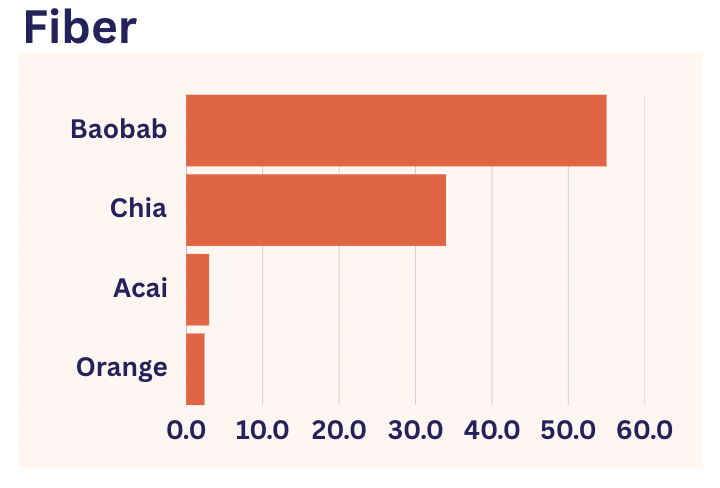
Baobab fruit powder is one of the world's most nutrient-dense functional ingredients, valued for its unique combination of prebiotic fiber, naturally occurring vitamin C, polyphenols, and essential minerals. Baobab delivers five times more vitamin C than oranges and five times more dietary fiber than oats, making it an exceptional ingredient for functional foods, beverages, nutraceuticals, and wellness products.
Its naturally occurring soluble and insoluble prebiotic fibers support digestive health, while a diverse spectrum of polyphenols contributes antioxidant activity. Baobab also provides key micronutrients, including magnesium, calcium potassium, and iron, along with B vitamins thiamin (B1), riboflavin (B2), niacin (B3), vitamin B6, and folate (B9).
Baobab fruit powder has a mild citrus flavor, excellent dispersibility, making it an ideal ingredient for beverage formulations, nutrition bars, dairy alternatives, dietary supplements, powdered drink mixes, confectionery, bakery products, and other innovative functional food applications.
Nutrition profile for 100 g
Total Carbohydrates
83.8 g
Total Sugars
25.3 g
Added Sugars
0 g
Protein
3.51 g
Fat
0.55 g
Vitamin C
319 mg
Magnesium
150 mg
Potassium
2600 mg
Iron
6.68 mg
Sodium
23.4 mg



220-350 cal
Calories
49.5 g
Dietary Fiber
237 mg
Calcium
The Science behind Baobab
Gut Health


Metabolism


Sports Nutrition
Baobab powder for your GLP -1 Companion product
Baobab research suggests that baobab's combination of polyphenols and fermentable fiber may influence several pathways relevant to metabolic health, including carbohydrate digestion, the gut microbiome, short-chain fatty acid production and incretin signaling. These mechanisms are generating interest in baobab as a functional ingredient for next-generation metabolic-health formulations

Applications
Food: Dietary supplements, energy and nutrition bars, cereals and granola, baked goods, yogurt, kefir, ice cream and non-dairy frozen desserts, baby food, meal replacements powders, pet food.
Beverage: Flavored waters, protein/fiber shakes, cold pressed juice, smoothies, tea blends
Preserving Biodiversity and Promoting Social Good
KAIBAE was inspired by the mighty Baobab tree. Once considered a lost crop™ the Baobab harvest now provides a critical source of income for our partnering communities in northern Ghana. Climate change, soil erosion, and disrupted rain patterns have resulted in lower agricultural yields, while a NTFP (Non-Timber Forest Project) such as KAIBAE’s provides a renewed and regenerative source of income. The KAIBAE harvest improves access to food, education, and healthcare and is now the #1 source of annual income for our community partners.


Frequently Asked Questions
-
KAIBAE is a leading organic baobab ingredient supplier, bulk baobab powder manufacturer, and baobab ingredient distributor in the USA. Since 2011, we have partnered with food, beverage, nutraceutical, and dietary supplement companies seeking premium-quality baobab ingredients backed by scientific expertise, exceptional quality standards, and transparent sourcing.
-
KAIBAE BAOBAB is wild harvested and meets USDA and EU organic standards.
-
The U.S. Food and Drug Administration approved Baobab powder in 2009 for use in food products in the United States.